If you’ve ever searched for something on Google and clicked one of the first few results, you’ve already experienced the power of Search Engine Optimization (SEO). Every day, billions of searches are made on search engines, and websites that appear on the first page receive the majority of clicks. This is why SEO has become one of the most valuable digital marketing skills.
At IT Vanilla, we believe that learning SEO should go beyond theory. Our practical, industry-focused training helps students, freelancers, and aspiring digital marketers understand how search engines work and apply proven SEO strategies to real-world websites and projects.
Whether you’re a digital marketer, business owner, freelancer, blogger, or student, understanding SEO can help you increase website traffic, generate leads, build brand awareness, and grow your online presence without relying solely on paid advertising. With the right guidance and hands-on learning approach from IT Vanilla, you can develop the skills needed to build a successful career in digital marketing and achieve long-term online success.
What is SEO?
SEO (Search Engine Optimization) is the process of improving a website so that it ranks higher in search engine results pages (SERPs) for relevant keywords.
The primary goal of optimization is to increase organic traffic, which refers to visitors who find your website through unpaid search results.
For example, if someone searches for:
- Best Digital Marketing Course
- SEO Training
- Learn WordPress
- Graphic Design Course
Google displays websites it believes provide the most relevant and trustworthy information. Optimize helps your website become one of those trusted results.
Why is SEO Important?
SEO is one of the most cost-effective digital marketing strategies because it brings targeted visitors who are already searching for your products, services, or information.
Some key benefits include:
- Increased organic website traffic
- Better brand visibility
- Higher search engine rankings
- More qualified leads
- Improved user experience
- Higher conversion rates
- Long-term marketing results
- Greater trust and credibility
Unlike paid advertising, good optimization can continue driving traffic for months or even years after your content is published.
How Does SEO Work?
Search engines like Google use sophisticated algorithms to determine which pages should appear first.
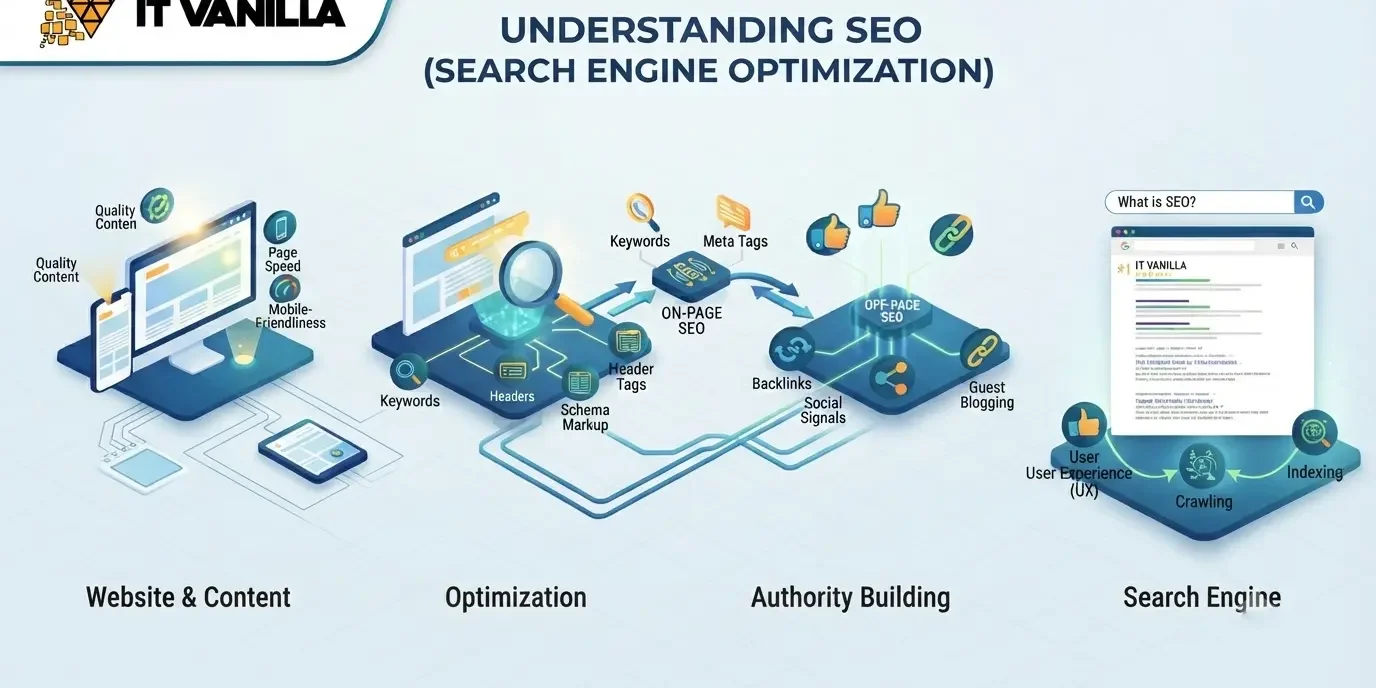
The SEO process generally includes three stages:
1. Crawling: Search engine bots discover pages by following links across the internet.
2. Indexing: Once a page is found, Google analyzes and stores it in its index.
3. Ranking: When someone searches for a keyword, Google evaluates hundreds of ranking factors to decide which pages deserve the highest positions.
Types of SEO
1. On-Page SEO
On-Page SEO focuses on optimizing elements within your website.
Examples include:
-
- Keyword optimization
<li
>SEO
- -friendly titles
- Meta descriptions
- Header tags (H1, H2, H3)
- Internal linking
- Image optimization
- Content quality
- URL optimization
2. Off-Page SEO
Off-Page SEO involves activities performed outside your website to improve authority and trust.
Examples include:
- Backlink building
- Guest posting
- Brand mentions
- Social media promotion
- Digital PR
3. Technical SEO
Technical optimization ensures that search engines can efficiently crawl and index your website.
Important areas include:
- Website speed
- Mobile responsiveness
- XML Sitemap
- Robots.txt
- HTTPS security
- Structured Data
- Core Web Vitals
- Canonical URLs
4. Local SEO
Local Optimize helps businesses appear in location-based searches.
For example:
- Restaurants
- Training institutes
- Hospitals
- Law firms
- Real estate agencies
Optimizing your business profile and collecting customer reviews are important parts of Local Optimize.
Major SEO Ranking Factors
Google considers hundreds of factors when ranking websites. Some of the most influential include:
- High-quality content
- Search intent
- Keyword relevance
- Backlink quality
- Website speed
- Mobile usability
- User experience
- HTTPS security
- Internal linking
- Domain authority
- Content freshness
- Core Web Vitals
Keyword Research
Keyword research is the foundation of every successful Optimize strategy.
It helps identify the words and phrases people use when searching online.
Keyword categories include:
Short-tail Keywords
Example:
<li
>SEO
- Digital Marketing
Long-tail Keywords
Example:
- What is SEO for beginners
- Best SEO Course for Digital Marketers
Long-tail keywords usually have lower competition and higher conversion potential.
On-Page SEO Best Practices
To optimize your content:
- Use your focus keyword naturally.
- Write compelling page titles.
- Create unique meta descriptions.
- Use only one H1 heading.
- Structure content with H2 and H3 headings.
- Add internal links.
- Include relevant external references when appropriate.
- Compress images.
- Add descriptive image ALT text.
- Improve readability with short paragraphs and bullet points.
Off-Page SEO Best Practices
Some effective strategies include:
- Earn high-quality backlinks.
- Publish guest articles.
- Create shareable content.
- Build relationships with industry websites.
- Increase brand mentions.
- Participate in relevant communities.
Quality backlinks remain one of Google’s strongest ranking signals.
Technical SEO Checklist
Ensure your website:
- Loads quickly
- Is mobile-friendly
- Uses HTTPS
- Has an XML Sitemap
- Has a Robots.txt file
- Fixes broken links
- Uses structured data
- Avoids duplicate content
- Has optimized URLs
Essential SEO Tools
Professional digital marketers commonly use:
- Google Search Console
- Google Analytics
- Google Keyword Planner
- Ahrefs
- SEMrush
- Screaming Frog
- Moz
- Ubersuggest
- GTmetrix
- PageSpeed Insights
These tools help monitor rankings, identify technical issues, and improve overall optimization performance.
Benefits of Learning SEO
Learning SEO can help you:
- Build a successful digital marketing career
- Work as a freelancer
- Grow your own business
- Increase website traffic
- Improve lead generation
- Enhance brand awareness
- Create long-term online growth
Optimization is one of the most in-demand skills in today’s digital economy.
<h2>SEO Trends in 2026
- AI-assisted content creation with human editing
- Helpful, experience-based content
- Voice search optimization
- Visual search
- Core Web Vitals optimization
- Search intent-focused content
- Entity-based SEO
- Topical authority
- EEAT (Experience, Expertise, Authoritativeness, Trustworthiness)
Staying updated with these trends helps maintain strong search performance.
Conclusion
Optimize is much more than inserting keywords into a webpage. It is a comprehensive strategy that combines high-quality content, technical optimization, user experience, and authority-building to help websites achieve better visibility in search engines.
For digital marketers, mastering Optimize is an essential investment in long-term career growth. By understanding how search engines work, conducting effective keyword research, creating valuable content, and following Optimize best practices, you can improve rankings, attract qualified visitors, and achieve sustainable online success.
Start with the fundamentals, stay consistent, and continue learning as search engine algorithms evolve. Over time, a well-planned optimization strategy can become one of the most powerful drivers of traffic, leads, and business growth.
FAQ
What does SEO stand for?
Search Engine Optimization.
<h3>Is SEO difficult to learn?
No. Beginners can learn the fundamentals with consistent practice and real-world projects.
How long does SEO take?
Optimize is a long-term strategy. Depending on your website, competition, and content quality, noticeable improvements may take several weeks to several months.
<h3>Is SEO better than paid advertising?
Optimize and paid advertising serve different purposes. Optimize builds sustainable organic traffic over time, while paid ads can generate immediate visibility.
Do I need coding skills for SEO?
Basic SEO can be performed without coding knowledge, though understanding HTML and technical concepts can be beneficial for advanced optimization.